
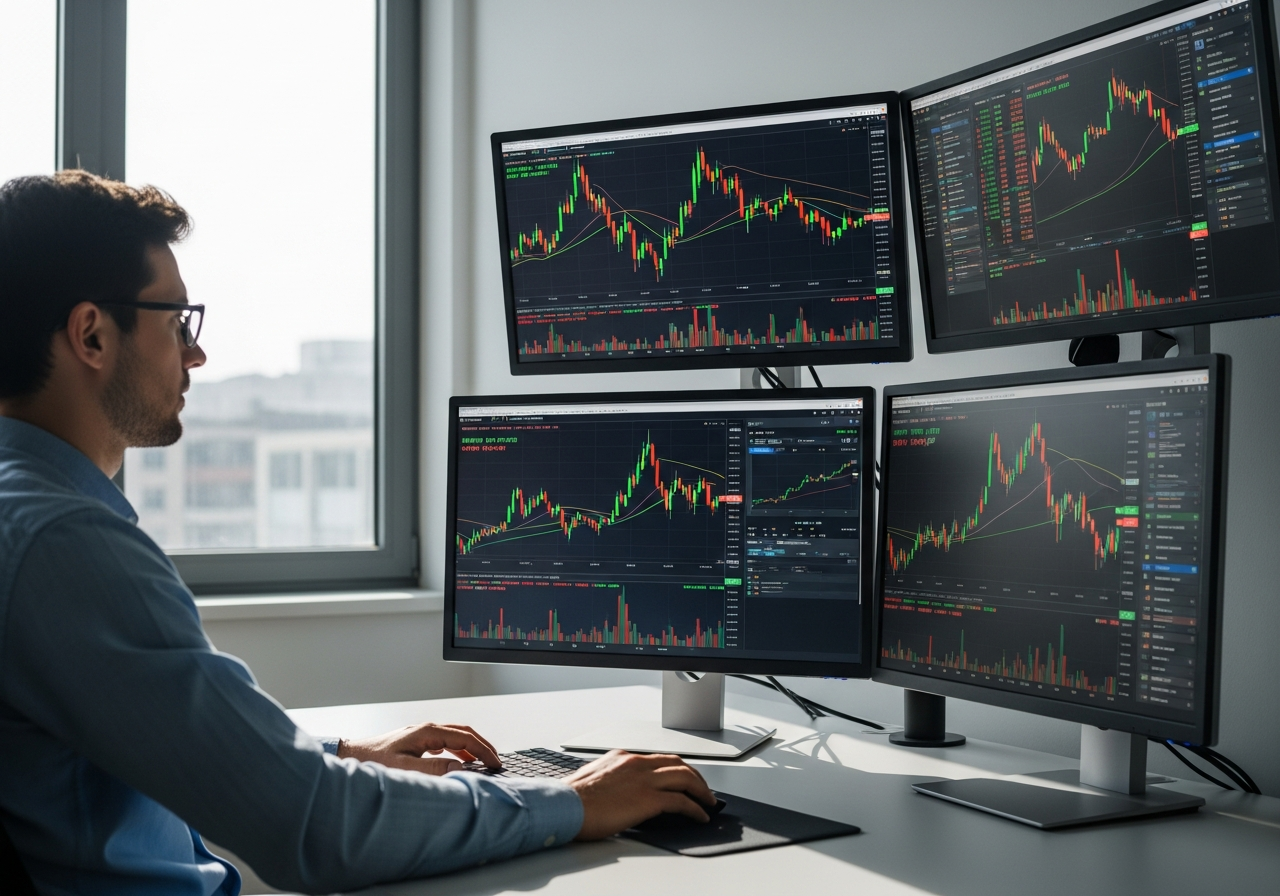
Crypto exchanges and trading basics
The global cryptocurrency market has exploded beyond $1 trillion in value, yet accessing this digital economy remains surprisingly straightforward for beginners. Modern crypto exchanges serve as the primary gateway for millions of traders worldwide, offering everything from simple buy-and-sell functionality to sophisticated trading instruments that rival traditional financial markets.
At their core, crypto exchanges come in two main flavors: centralized exchanges (CEX) like Binance and Coinbase that operate similarly to traditional brokers, and decentralized exchanges (DEX) such as Uniswap that facilitate peer-to-peer trading without intermediaries. Both platforms support various trading types including spot trading, futures contracts, and margin trading, though they differ significantly in their approach to user verification (KYC) and security protocols.
This comprehensive guide walks you through the step-by-step process of navigating crypto exchanges, from account setup to executing your first trade, while highlighting the inherent risks and reward opportunities that define this volatile yet potentially lucrative market.
What is a Crypto Exchange?
A crypto exchange is a digital platform that enables users to buy, sell, and trade cryptocurrencies using either traditional fiat currencies or other digital assets. These platforms function as intermediaries, matching buyers with sellers and providing the technological infrastructure necessary to execute transactions securely and efficiently.
Beyond simple trading, crypto exchanges play a crucial role in bridging the gap between traditional financial systems and the decentralized world of digital currencies. They provide fiat-to-crypto on-ramps that allow users to convert dollars, euros, or other government-issued currencies into Bitcoin, Ethereum, and thousands of alternative cryptocurrencies, while also offering the reverse process for cashing out digital assets.
Centralized vs Decentralized Exchanges
The fundamental distinction between centralized and decentralized exchanges lies in how they handle user funds, verification processes, and operational control. Understanding these differences is essential for choosing the right platform for your trading needs.
| Feature | CEX (e.g. Binance, Coinbase) | DEX (e.g. Uniswap) |
|---|---|---|
| Liquidity | High liquidity, tight spreads | Variable liquidity, wider spreads |
| KYC Requirements | Mandatory identity verification | Anonymous trading possible |
| Custody | Exchange holds your funds | User maintains wallet control |
| Privacy | Limited privacy, regulated | Enhanced privacy, pseudonymous |
| User Experience | Intuitive interfaces, customer support | Technical complexity, self-reliant |
Centralized exchanges typically offer superior liquidity due to their large user bases and market-making activities, resulting in tighter bid-ask spreads and faster order execution. However, this convenience comes at the cost of mandatory KYC verification and the need to trust the exchange with custody of your funds.
Decentralized exchanges operate on blockchain networks using smart contracts, eliminating the need for a central authority to hold user funds. While this approach maximizes user control and privacy, it often results in higher transaction fees and requires greater technical knowledge to navigate effectively.
Hybrid Exchanges Overview
Hybrid exchanges represent an emerging category that combines the best aspects of both centralized and decentralized models. These platforms typically offer the high liquidity and user-friendly interfaces of centralized exchanges while incorporating decentralized elements such as non-custodial trading or blockchain-based settlement.
By blending CEX liquidity with DEX security features, hybrid exchanges aim to provide institutional-grade trading capabilities without sacrificing user control over private keys and funds. Examples include platforms that use centralized order matching but execute trades through decentralized smart contracts, offering a compelling middle ground for security-conscious traders who still want professional trading features.
How Crypto Exchanges Work
Understanding the mechanics behind crypto exchange operations helps demystify the trading process and builds confidence for newcomers. The basic workflow involves several interconnected systems working together to facilitate secure, efficient transactions between users across the globe.
- Account Creation: Users register with an email address and create secure passwords, often with two-factor authentication enabled from the start
- Identity Verification: Most centralized exchanges require KYC compliance, involving document uploads and identity verification that can take 24-48 hours
- Deposit Funds: Users transfer fiat currency via bank transfers or deposit existing cryptocurrencies from external wallets using unique deposit addresses
- Place Orders: Traders select trading pairs, choose order types, and specify quantities and prices for their desired transactions
- Order Matching: The exchange’s matching engine pairs buy and sell orders based on price and time priority, executing trades automatically
- Settlement and Withdrawal: Completed trades are settled instantly, with users able to withdraw funds to external wallets or bank accounts after paying applicable fees
KYC and Security Processes
Know Your Customer (KYC) verification has become the standard for centralized crypto exchanges, driven by regulatory compliance requirements in most jurisdictions. The process typically involves submitting government-issued identification, proof of address, and sometimes additional documentation for higher withdrawal limits or advanced trading features.
While KYC requirements may seem burdensome, they serve important purposes including anti-money laundering compliance, fraud prevention, and enabling fiat currency integration with traditional banking systems. Most reputable exchanges use bank-level security measures to protect submitted documents and personal information.
In contrast, decentralized exchanges operate without KYC requirements since they don’t custody user funds or facilitate fiat transactions. This approach appeals to privacy-focused users but limits access to fiat on-ramps and may complicate tax reporting and regulatory compliance in certain jurisdictions.
Types of Crypto Trading
Crypto exchanges offer various trading methods to accommodate different investment strategies, risk tolerances, and market outlooks. Each trading type serves specific purposes and comes with distinct advantages and considerations for both novice and experienced traders.
| Trading Type | Description | Best For |
|---|---|---|
| Spot Trading | Immediate buy/sell of cryptocurrencies at current market prices | Beginners, long-term investors |
| Futures Trading | Contracts to buy/sell assets at predetermined prices on future dates | Experienced traders, hedging strategies |
| Margin Trading | Borrowing funds to amplify trading positions with leverage | Risk-tolerant traders seeking higher returns |
| Options Trading | Rights to buy/sell assets at specific prices within set timeframes | Advanced traders, portfolio protection |
| P2P Trading | Direct trading between individuals with escrow services | Privacy-focused users, cash transactions |
Spot Trading Basics
Spot trading represents the most straightforward approach to cryptocurrency trading, involving the immediate purchase or sale of digital assets at prevailing market prices. When you execute a spot trade, you take actual ownership of the cryptocurrency, which is then held in your exchange account or can be transferred to a personal wallet for enhanced security.
This trading method appeals particularly to beginners and long-term investors because it involves no leverage, complex derivatives, or time-sensitive contracts. The risk is limited to the amount invested, and profits are realized through price appreciation or favorable exchange rate movements between different cryptocurrencies.
Spot trading also serves as the foundation for more advanced strategies, as understanding market dynamics, order types, and price action in the spot market provides essential knowledge before progressing to derivatives or leveraged products that amplify both potential gains and losses.
Advanced Trading: Futures and Margin
- Leverage amplification allows traders to control larger positions with smaller capital amounts, potentially multiplying gains but equally magnifying losses and liquidation risks
- Futures contracts enable speculation on price direction without owning underlying assets, offering opportunities to profit from both rising and falling markets
- Margin requirements vary by exchange and asset, typically ranging from 2x to 125x leverage, with higher leverage requiring smaller initial deposits but increased volatility exposure
- Risk management becomes critical as leveraged positions can be automatically liquidated when losses approach the initial margin, potentially wiping out entire account balances
- Advanced order types like stop-losses and take-profits become essential tools for managing leveraged positions and protecting against adverse market movements
Crypto Order Types Explained
Understanding different order types is crucial for executing effective trading strategies and managing risk in volatile cryptocurrency markets. Each order type serves specific purposes and offers varying degrees of control over trade execution, timing, and price optimization.
- Market Orders execute immediately at the best available price, providing instant fills but potentially suffering from slippage during volatile periods or low liquidity conditions
- Limit Orders specify exact prices for buying or selling, offering price control but no guarantee of execution if market prices don’t reach specified levels
- Stop-Loss Orders automatically sell positions when prices fall to predetermined levels, protecting against major losses but risking premature exits during temporary price dips
- Stop-Limit Orders combine stop-loss triggers with limit order execution, providing both downside protection and price control but potentially failing to execute in fast-moving markets
- Take-Profit Orders automatically close profitable positions at target prices, locking in gains but potentially missing additional upside if trends continue
- Iceberg Orders split large trades into smaller portions to minimize market impact, helping institutional traders avoid moving prices unfavorably against their positions
- Fill-or-Kill Orders require immediate complete execution or automatic cancellation, useful for traders who need entire positions filled at specific prices or prefer not to trade at all
Order Book Mechanics
The order book serves as the heart of exchange trading systems, displaying real-time lists of buy orders (bids) and sell orders (asks) organized by price levels. Bids represent the highest prices buyers are willing to pay, while asks show the lowest prices sellers are willing to accept, with the spread between them indicating market liquidity and trading costs.
When new orders enter the system, the exchange’s matching engine automatically pairs compatible buy and sell orders based on price-time priority, executing trades at the best available prices. This continuous process creates the price discovery mechanism that determines market values for cryptocurrencies, with deeper order books generally indicating more liquid and stable markets.
Understanding order book dynamics helps traders make informed decisions about order placement, timing, and price expectations. Large orders near current market prices suggest strong support or resistance levels, while thin order books indicate potential for significant price movements with relatively small trading volumes.
Key Features of Top Exchanges
Leading cryptocurrency exchanges distinguish themselves through superior liquidity, comprehensive fiat currency support, and competitive fee structures that attract both retail and institutional traders. These platforms invest heavily in technology infrastructure, security measures, and user experience optimization to maintain their market positions.
| Exchange | Liquidity | Fiat Support | Fees |
|---|---|---|---|
| Binance | Highest global volume | 60+ fiat currencies | 0.1% spot, discounts available |
| Coinbase | High US market depth | USD, EUR, GBP, CAD | 0.5% maker/taker |
| Kraken | Strong European presence | Multiple European currencies | 0.16-0.26% tiered |
| Bybit | Derivatives-focused liquidity | Limited fiat options | 0.1% spot, 0.075% futures |
Liquidity and Trading Pairs
Liquidity represents the ease with which assets can be bought or sold without significantly impacting market prices, making it one of the most critical factors when selecting a crypto exchange. High liquidity ensures tighter bid-ask spreads, faster order execution, and reduced slippage costs, particularly important for large trades or volatile market conditions.
Trading pair availability determines which cryptocurrencies can be directly exchanged against each other, with major exchanges offering hundreds of pairs including BTC, ETH, and stablecoin bases. Popular pairs like BTC/USDT and ETH/BTC typically offer the highest liquidity, while exotic altcoin pairs may have wider spreads and higher volatility due to lower trading volumes.
Fees and Costs Breakdown
Understanding the complete fee structure of crypto exchanges is essential for optimizing trading profitability, as costs can vary significantly between platforms and accumulate quickly for active traders. Most exchanges employ tiered fee schedules based on trading volume, offering reduced rates for high-volume users.
| Fee Type | Typical Range | Tips to Minimize |
|---|---|---|
| Trading Fees | 0.1% – 0.5% | Use limit orders, hold exchange tokens |
| Deposit Fees | 0% – 3.99% | Choose crypto deposits, avoid credit cards |
| Withdrawal Fees | $1 – $50 | Batch withdrawals, use low-fee networks |
| Funding Fees | ±0.01% – 0.375% | Close positions before funding times |
Trading fees typically follow maker-taker models where limit orders that add liquidity (maker) receive lower fees than market orders that remove liquidity (taker). Many exchanges offer additional discounts for users holding native exchange tokens or meeting certain volume thresholds.
How to Start Trading Crypto
Beginning your crypto trading journey requires careful preparation, starting with selecting a reputable exchange that matches your needs and gradually building knowledge through small, manageable trades. The process involves several sequential steps that build upon each other to create a solid foundation for trading success.
- Research and select a beginner-friendly exchange based on your location, preferred payment methods, and available cryptocurrencies
- Complete account registration with strong passwords and enable two-factor authentication for enhanced security
- Submit required KYC documentation and wait for verification approval, which typically takes 24-72 hours
- Make your first deposit using bank transfer, debit card, or cryptocurrency from another wallet
- Familiarize yourself with the platform interface, trading pairs, and order types through demo features or small test trades
- Execute your first trade using limit orders to maintain price control and minimize fees
- Practice risk management by starting with small amounts and gradually increasing position sizes as you gain experience
Choosing Your First Exchange
Selecting your first crypto exchange requires balancing multiple factors including reputation, security track record, available cryptocurrencies, and regulatory compliance in your jurisdiction. Established exchanges with strong security histories and regulatory approval offer safer starting points for beginners, even if they charge slightly higher fees than newer platforms.
Geographic considerations play a crucial role, as different exchanges serve different regions and offer varying levels of local currency support and payment method integration. US users might prefer Coinbase or Kraken for regulatory compliance, while international users often gravitate toward Binance for its extensive cryptocurrency selection and global accessibility.
Feature requirements should align with your trading goals and experience level. Beginners benefit from intuitive interfaces, educational resources, and responsive customer support, while more experienced traders might prioritize advanced order types, API access, and lower fees.
Volume and liquidity considerations become important as your trading activity increases, with higher-volume exchanges typically offering better price stability and faster order execution. Reading recent user reviews and checking security audit reports can provide valuable insights into platform reliability and user satisfaction levels.
Risk Management and Trading Tips
Effective risk management forms the cornerstone of successful cryptocurrency trading, as the inherent volatility of digital assets can lead to significant gains or devastating losses within short timeframes. Implementing systematic approaches to position sizing, diversification, and loss limitation helps preserve capital during adverse market conditions while allowing participation in upward price movements.
Volatility in cryptocurrency markets far exceeds traditional assets, with daily price swings of 10-20% considered normal for major cryptocurrencies and even larger movements possible for smaller altcoins. This volatility creates opportunities for substantial profits but equally poses risks of rapid capital destruction if proper safeguards aren’t implemented.
Diversification across different cryptocurrencies, trading strategies, and timeframes can help reduce overall portfolio risk while maintaining growth potential. However, correlation between crypto assets tends to increase during market stress, making traditional diversification less effective than in other asset classes and requiring additional risk management techniques.
Common Beginner Mistakes
- Overtrading driven by emotion or excitement leads to excessive fees, poor decision-making under pressure, and increased exposure to market volatility
- Ignoring fee structures results in profits being eroded by trading costs, withdrawal fees, and unfavorable exchange rates, particularly impactful for smaller accounts
- Lack of research before investing in projects leads to investment in scams, failed projects, or fundamentally flawed cryptocurrencies with no real utility
- FOMO (Fear of Missing Out) drives hasty decisions to chase price pumps, often resulting in buying at peaks and selling at lows during emotional reactions
- Neglecting security practices such as weak passwords, storing funds on exchanges, or falling for phishing attacks can result in permanent loss of funds
- Using excessive leverage amplifies both gains and losses, with many beginners underestimating liquidation risks and losing entire account balances during volatile periods
Strategies for Beginners
Dollar-cost averaging represents one of the most beginner-friendly strategies, involving regular purchases of cryptocurrencies regardless of price to smooth out volatility over time. This approach removes the pressure of timing markets perfectly while building positions gradually, particularly effective for long-term investors who believe in cryptocurrency adoption.
Arbitrage opportunities occasionally arise between different exchanges when price discrepancies create risk-free profit potential, though these opportunities require quick execution and sufficient capital to cover transaction fees. Beginning arbitrage traders should start with simple price differences rather than complex strategies involving futures or options markets.
Why Use Crypto Exchanges?
Crypto exchanges provide essential infrastructure that makes digital asset trading accessible to millions of users worldwide, offering professional-grade tools and liquidity that would be impossible to achieve through direct peer-to-peer transactions. These platforms serve as crucial bridges between traditional financial systems and the emerging decentralized economy.
| Pros | Cons | Mitigation |
|---|---|---|
| High liquidity and tight spreads | Centralization and hacking risks | Use cold storage, diversify across platforms |
| Fiat currency integration | KYC requirements reduce privacy | Use DEX for privacy-focused trading |
| Advanced trading features | Regulatory compliance restrictions | Research local regulations, use compliant platforms |
| Customer support and user experience | Trading fees and withdrawal costs | Compare fee structures, use volume discounts |
| Insurance and security measures | Potential for market manipulation | Trade on high-volume pairs, use limit orders |
Future of Crypto Trading
The evolution of cryptocurrency trading continues accelerating with increasing institutional adoption, regulatory clarity, and technological innovations that promise to reshape how digital assets are traded. Decentralized finance (DeFi) protocols are gaining market share by offering yield farming, automated market making, and novel trading mechanisms that challenge traditional exchange models.
Regulatory developments across major jurisdictions will likely standardize compliance requirements, potentially reducing regulatory arbitrage between exchanges while increasing consumer protections and institutional participation. This regulatory maturation could lead to greater mainstream adoption and integration with traditional financial services, creating new hybrid products that blend crypto and traditional assets.